Updated: July 26th, 2010
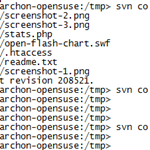 This is a quick recipe that I found pretty interesting and relatively unknown.
Everyone who uses SVN knows that most repositories are set up to allow viewing of their contents via a web browser. For example, here's the trunk of WP Plugins SVN: http://plugins.svn.wordpress.org/ and here is the current trunk version of a specific file, let's say http://plugins.svn.wordpress.org/stats/trunk/readme.txt.
The Problem
However, what if you wanted to view a specific revision of a file or directory in your browser?
Let's say I wanted revision 100,000 of http://plugins.svn.wordpress.org/stats/trunk/readme.txt
Normally, on a command line, you'd do something like
svn co http://plugins.svn.wordpress.org/stats/trunk/readme.txt stats cd stats; svn up -r100000 readme.txt |
or simply
Updated: July 30th, 2021
The Problem
I am throwing up a quick post about a relatively cryptic error that Solr started throwing the other day here at Plaxo. After happily running for a few days, I suddenly started getting pages about failed Solr indexing.
Upon closer examination, I saw the following repeatedly in the log file:
catalina.2009-09-18.log:SEVERE: java.io.IOException: directory 'DATADIR/index' exists and is a directory, but cannot be listed: list() returned null |
I tried to see if sending an OPTIMIZE command would help but the server returned the same response.
Digging Deeper
The reason was these errors was quite simple – Solr was running …
Updated: June 9th, 2009
Problem
While writing a 1093985th Perl script the other day I was facing the following dilemma:
- Let’s say there is a local library, called TheUberLib.pm. It is so uber that most of my scripts, located all over the machine, include it.
- Now, let’s also say that there’s an even more uberly important binary called run_me_now_or_you_will_die but the only way to find it is by using a relative path to the aforementioned TheUberLib.pm, for example ../bin (RELATIVE TO TheUberLib.pm).
- I don’t want to hardcode the path to run_me_now_or_you_will_die because it can be different on multiple machines and the code wouldn’t be robust enough – all I know is that the path is relative to an included library.
So …
 beer planet is a blog about technology, programming, computers, and geek life. It is run by Artem Russakovskii - a local San Francisco geek who is currently pursuing his own projects and regularly enjoys hacking Android, PHP, CSS, Javascript, AJAX, Perl, and regular expressions, working on Wordpress plugins and tools, tweaking MySQL queries and server settings, administering Linux machines, blogging, learning new things, and other geeky stuff.


